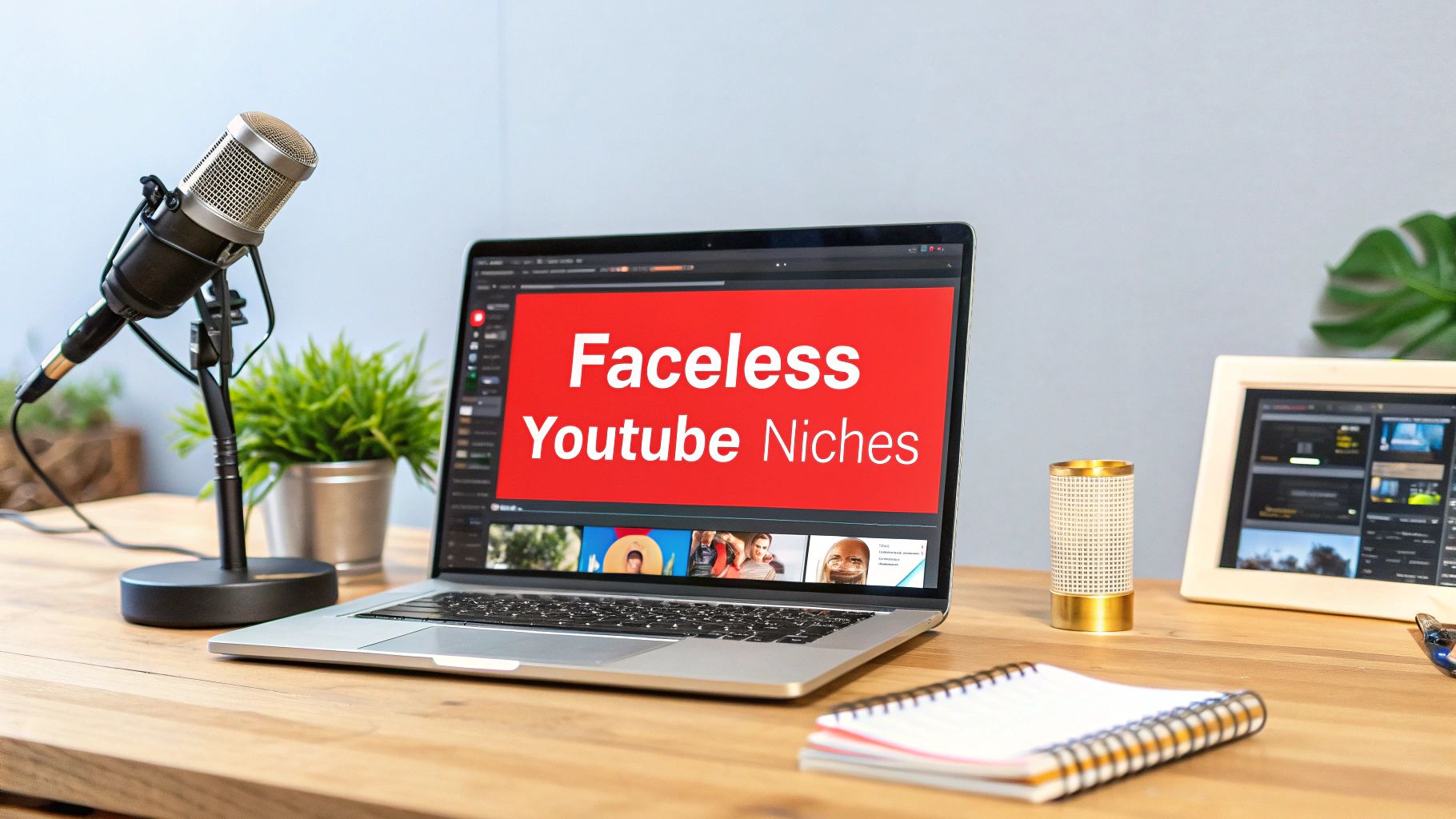
There is no universal “best” faceless YouTube niche. The strongest choice is a subject where you can repeatedly produce original evidence, secure the necessary rights, explain why each video is distinct and find a real viewer question in YouTube Studio. A niche that looks popular but depends on copied clips, interchangeable scripts or unsupported income assumptions is a weak starting point.
This guide compares seven faceless niche families by the proof they require. Use it to build a shortlist before you choose a production format, software stack or revenue model.
Start with four non-negotiable gates
A faceless channel removes an on-camera host. It does not remove authorship, responsibility or the need for original value. Reject a niche before scoring it if any of these gates fails:
- Source gate: you can identify the records, demonstrations, recordings, data or expertise that will support each video.
- Rights gate: you can document the ownership, license or permission for every recurring visual and audio input.
- Contribution gate: a reviewer can explain what your research, narration, analysis, demonstration or editing adds.
- Repeatability gate: you can make several materially different videos without turning the channel into one template with new nouns.
YouTube’s current channel monetization policies focus on original, authentic value and distinguish reused content from repetitive or mass-produced inauthentic content. The review applies at channel level, and copyright remains a separate question. Passing one gate does not satisfy the others.
Compare seven faceless niche families
| Niche family | Original evidence to own | Main preflight risk |
|---|---|---|
| Software and workflow tutorials | Your own screen recordings, tested steps, version notes and correction log | Outdated interfaces or a script that repeats documentation without a tested demonstration |
| Hands-only demonstrations | Your own footage, materials, measurements, safety notes and finished result | Unclear claims, unsafe steps or borrowed footage presented as a demonstration |
| Original data explainers | Dataset provenance, calculation sheet, chart source and method notes | Misleading scales, mixed date ranges or conclusions the data does not support |
| Narrated history or science explainers | Primary sources, expert references, fact review and original diagrams | Unlicensed archival media or a narration that merely reads other material |
| Gaming analysis and guides | Your own capture, tested strategy, commentary and version or patch record | Publisher restrictions, copied compilations or guides made obsolete by updates |
| Animation and diagram explainers | Original script, storyboard, asset licenses and scene-level editorial choices | Generic generated scenes and interchangeable narration that look mass-produced |
| Ambient audio, ASMR and field recording | Original recordings, location permission, session log and audio-rights record | Third-party music, near-duplicate uploads or recordings that cannot be traced |
The table is a proof map, not an earnings ranking. A subject can fit more than one family. Choose the row that describes how you will create evidence, because that determines the real production burden.
Software and workflow tutorials
This niche works well when you can perform the process yourself and record the actual interface. A useful tutorial shows the starting state, exact clicks, expected result, likely failure points and the date or version checked. It should tell viewers where the workflow varies by plan, device, country or account permissions.
Keep on the shortlist when: you have legitimate access to the product, can repeat the task, and can update or annotate the video when the interface changes.
Reject or narrow it when: the workflow requires an account you cannot access, the claims come only from search snippets, or the screen recording cannot show the promised result.
A faceless tutorial can still have a clear authorial contribution: the tested path, error recovery, comparison and decision rule are yours.
Hands-only demonstrations
Cooking, repair, craft, drawing, product setup and lab-style demonstrations can be faceless because the work itself is visible. The proof is the continuous relationship between the materials, steps and result. Record enough context that a viewer can distinguish a real demonstration from a montage.
Keep on the shortlist when: you can film the work, explain measurements and constraints, and show the result without relying on a copied before-and-after image.
Reject or narrow it when: the process is unsafe to demonstrate, your result cannot be reproduced, or health, financial or performance claims would need qualified review you do not have.
Record failed attempts and corrections. They often provide more useful viewer value than a perfect sequence with no explanation.
Original data explainers
Data explainers can work without a presenter when the method is visible. The channel’s identity comes from how it chooses questions, cleans data, labels uncertainty and turns a result into a useful decision. Save the source, extraction date, filters, formulas and chart version for every episode.
Keep on the shortlist when: you have a stable data source, can explain the calculation, and can publish the limits alongside the finding.
Reject or narrow it when: important values are estimated but presented as measured, date ranges differ across comparisons, or the chart is more confident than the source.
Do not convert a public popularity list into an earnings claim. Audience size, advertiser spending, creator revenue and profit are different records.
Narrated history or science explainers
This family depends on research quality and original synthesis. The faceless format can use maps, diagrams, timelines, public-domain materials and licensed archival sources, but the narration should make a distinct argument rather than read an article aloud.
Keep on the shortlist when: you can reach primary or authoritative sources, record where claims disagree, and create original explanatory visuals.
Reject or narrow it when: the planned video depends on film, television or news clips whose use has not been reviewed, or when the script is a lightly rewritten source.
YouTube’s fair-use guidance explains that credit and disclaimers do not automatically make copied material fair use. Fair use is fact-specific and ultimately decided by courts. Build the niche around material you can lawfully use, not around a disclaimer.
Gaming analysis and guides
Gameplay can supply the visual layer while your tested strategy, critique or explanation supplies the value. Record the game, platform, mode and patch or version. For a guide, keep the successful and failed attempts that show why the method works. For analysis, connect specific moments to your argument rather than using gameplay as generic background.
Keep on the shortlist when: you can capture your own sessions, follow the publisher’s rules and update advice when the game changes.
Reject or narrow it when: the plan is a compilation of other creators’ clips, every episode repeats the same untested list, or the footage rights are unclear.
A creator’s commentary can be original while the underlying game remains someone else’s intellectual property. Keep the publisher rules and content-rights record with the production file.
Animation and diagram explainers
Animation is useful when the subject needs a visual model rather than literal footage. A defensible workflow begins with an original question, source-backed script and storyboard. Scene choices should explain the idea, not merely decorate a generic narration.
Keep on the shortlist when: your team can design scenes around specific claims, document asset rights and make each episode visually distinct.
Reject or narrow it when: the system produces interchangeable scenes, cannot trace a visual to its license, or invents realistic evidence that could be mistaken for a real event.
If realistic content is generated or meaningfully altered, review YouTube’s current altered and synthetic content disclosure guidance. Disclosure does not replace accuracy, rights or originality review.
Ambient audio, ASMR and field recording
This niche is strongest when the recordings are genuinely yours and each session has a clear setting or purpose. Save the date, location, equipment, people or property permissions, edits and any separate music license. A long runtime is not original value by itself.
Keep on the shortlist when: you can capture clean original audio, vary the real recording conditions and maintain a session ledger.
Reject or narrow it when: the plan depends on third-party music, recycled loops or dozens of near-identical uploads that cannot be distinguished.
For relaxation or wellbeing framing, describe the listening experience accurately. Avoid medical promises unless they are supported and reviewed for that purpose.
Use first-party audience signals
Do not call a niche “in demand” because several public channels are large. Their audience, history and distribution are not your evidence. Use the signals available to your own channel or an account you are authorized to review.
YouTube’s current Analytics guide describes the Trends tab as a way to explore searches and content gaps. The Content, Reach and Engagement tabs show how your existing videos are found and watched. The Audience tab can show what your viewers watch, channels they watch and formats they use, although some reports may be limited.
For each candidate niche, save:
- the exact Trends query or content gap and the date checked;
- related videos or formats your authorized audience watches;
- which existing videos, if any, already attract the same viewer problem;
- whether the evidence is channel-specific, platform-wide or unavailable;
- the question the first video will answer better than the current options.
Unknown is a valid result. Do not replace missing audience evidence with a universal popularity or profitability claim.
Build a shortlist record
Score each remaining niche from 0 to 2 on six fields:
- Source access: 0 unknown, 1 inconsistent, 2 repeatable and documented.
- Rights clarity: 0 unknown, 1 mixed, 2 owned or licensed with a saved record.
- Distinct contribution: 0 interchangeable, 1 partly original, 2 a clear method, demonstration or analysis.
- Production fit: 0 missing capability, 1 difficult, 2 achievable with the current team and equipment.
- Audience signal: 0 unavailable, 1 indirect, 2 current first-party evidence.
- Update burden: 0 unmanageable, 1 periodic repair needed, 2 stable or supported by a defined update process.
Do not total a niche that scored zero on source access, rights clarity or distinct contribution. Those are gates. A high audience score cannot compensate for an input you cannot legally or credibly produce.
| Decision | Use when | Next evidence |
|---|---|---|
| Proceed | All three gates pass and the production path is credible | Choose a format and create a bounded production brief |
| Condition | The niche fits, but one documentable dependency remains | Resolve the license, source, reviewer or equipment requirement first |
| Hold | Audience evidence is unknown or the update burden is unclear | Collect current Studio evidence or test the workflow privately |
| Reject | A source, rights or contribution gate fails | Change the niche or the underlying production method |
A hypothetical shortlist example
This example is illustrative. A two-person team is choosing between software tutorials, gaming news compilations and original data explainers.
- The team can access and test one analytics product, record its own screen and document interface changes. Software tutorials pass all three gates.
- The gaming idea depends on clips from other channels and generic narration. Rights clarity and distinct contribution score zero, so it is rejected before audience scoring.
- The data idea uses an open dataset, but the team has not built a reproducible calculation sheet. It is conditioned on saving the data version, formulas and chart review.
The example does not predict which niche will gain views or earn money. It shows why a small, documented capability can be stronger than a popular topic with unresolved inputs.
Connect the shortlist to the next decision
Once one or two niches pass the gates, use the faceless format evidence guide to choose how each video will be made and documented. Use the high-paying niche evidence sheet only when you have authorized, same-period revenue and cost records. If production includes automated steps, use the auditable automation workflow guide to define human review and stop conditions.
If you are evaluating an established channel from the account catalog or comparing YouTube channel options, keep the niche decision separate from ownership, policy history, existing audience, content rights and included working files. A channel label does not prove that its source system will transfer or that its audience will fit a new plan.
Frequently asked questions
What is the easiest faceless YouTube niche?
There is no universal easiest niche. The easiest credible option is the one where you already control the sources, rights, equipment and expertise required for repeated original videos.
Which faceless niche makes the most money?
No public niche list can establish future income for your channel. Compare authorized same-period revenue, costs and external revenue separately. Keep public views and advertiser CPM claims out of an earnings conclusion.
Can a faceless channel join the YouTube Partner Program?
Not showing a face is not the deciding factor. YouTube reviews channel content and policy compliance, including originality, authenticity, reused content and repetitive mass production. Eligibility and continued monetization are not guaranteed.
Can I use stock footage?
Only with a valid rights basis, and the license does not by itself establish original value. Save the license and add substantive analysis, narrative, education or other contribution that is clear in the finished video.
Can I use an AI voice or generated images?
A tool does not remove responsibility for accuracy, rights, impersonation risk, disclosure and originality. Review the complete video, document the inputs and apply the current disclosure setting when realistic content was generated or meaningfully altered.
Should I copy a successful faceless channel’s niche?
Use public channels to understand viewer questions and presentation patterns, not as proof that the same topic will work for you. Build your own source, rights, contribution and audience record.
Choose the proof you can repeat
Start with three candidate niches. Apply the source, rights and contribution gates, then score production fit, audience evidence and update burden. Keep one or two niches whose proof system your team can actually maintain. The next step is to choose a production format and prepare a small, reviewable brief, not to assume reach or revenue.
Official YouTube guidance and live internal links were checked on November 18, 2026. Policies, Studio reports and interfaces can change. This guide provides a shortlisting method and does not promise views, YPP approval, continued monetization, payment or future performance.