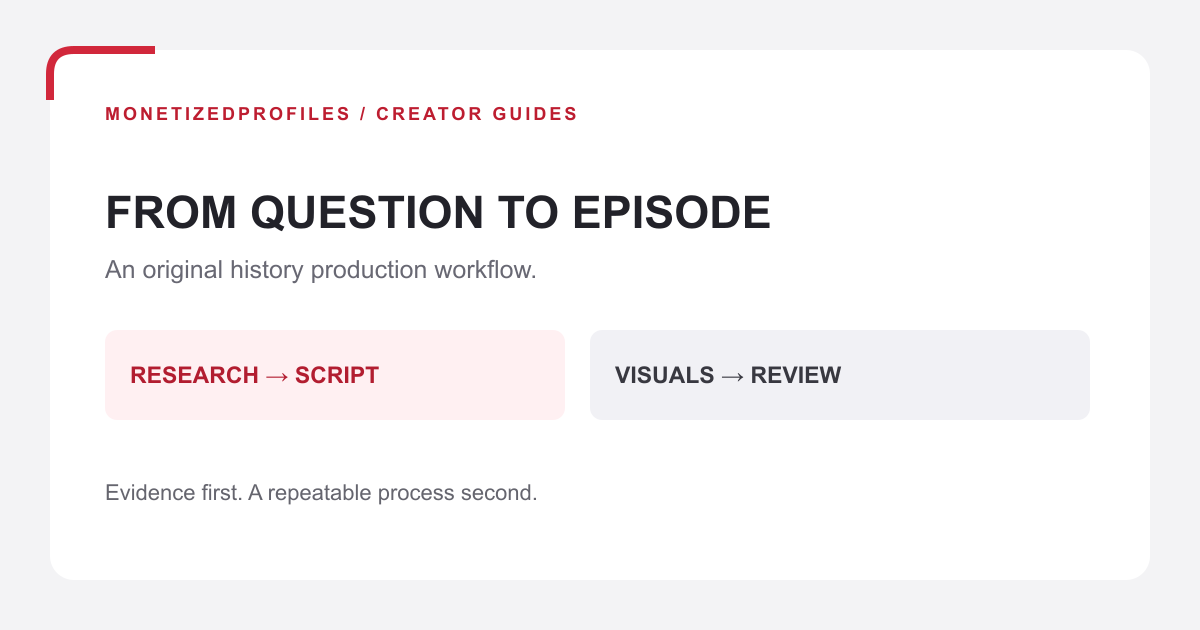
A workable starting plan: Pick one historical question, build a claim-by-claim source record, write an original explanation, track asset rights, then review the finished video against the evidence. Set the upload schedule from measured production capacity.
A faceless history channel needs a clear editorial contribution. A sequence of archive images with a generic narration can explain very little, even when it looks polished. Start with a question worth answering, then build the research, script and visuals around that answer.
The workflow below is a practical production model, not a promise of views or advertising revenue. It is designed for a small team that wants each video to contain a distinct argument and a traceable set of sources.
Choose a question you can actually answer
'The history of transport' is too broad for a useful first brief. 'Why did this railway take this route?' gives the researcher something specific to investigate. 'How did this city supply drinking water before modern plumbing?' creates a natural sequence of problems and solutions.
For each idea, write one sentence describing the viewer's likely question and another describing your proposed answer. If the answer is only a list of dates, keep researching. The video needs a connection, explanation or comparison that makes those dates matter.
Build a source record before the script
Create a simple research sheet with a row for each important claim. Include the claim, the source, the relevant passage or page number, the source's date and any disagreement you found. Museum collections, contemporary records and scholarly histories can contribute different kinds of evidence; do not treat a dramatic anecdote as established merely because several websites repeat it.
Keep two separate columns for facts and interpretation. A record may establish when a project opened without establishing why everyone supported it. If the evidence does not resolve a question, the script can say so. That is more useful than filling the gap with invented certainty.
Make the script do original work
Organize the episode around a small number of explanatory turns: the situation, the problem, the attempted solution and its consequences. Give the narrator a reason to move from one section to the next. A map can explain a constraint; a comparison can show how an alternative would have worked.
YouTube's monetization policies distinguish original, authentic work from repetitive or mass-produced material. Reused material needs substantial original contribution to meet that policy, and permission to use a clip does not by itself settle monetization eligibility. Use these requirements as a review standard for the whole channel, not as a formula that guarantees approval.
For example, instead of reading a timeline over stock footage, write an explanation of the decisions that shaped the outcome. Commission a clear diagram, compare two documented proposals, or show how a commonly repeated claim differs from the available evidence. Those are editorial choices your team can own.
Track visuals and audio separately from research
A source that supports a historical fact does not automatically grant permission to use its photographs. Keep an asset register identifying the creator or collection, the licence or permission, any attribution requirement and the file used in the edit. Save the relevant documentation with the project.
YouTube requires the necessary commercial-use rights for visual and audio material used in monetized content. Its content monetization guide explains why the source and licence matter. Do not assume an image is available for unrestricted use just because the event it depicts happened a long time ago.
For music, YouTube's Audio Library is one documented option. Some tracks require attribution, so check the licence and copy the required credit where applicable. See the Audio Library instructions. Keep the exact track information in your asset register so another editor can reproduce the decision.
Label reconstructions before they become evidence
Keep a scene note that says whether each visual is a historical record, an explanatory diagram or a reconstruction. A generated image of a railway committee meeting cannot establish who attended, how the room looked or what anyone said. Describe invented visuals as illustrations; do not give them the appearance of an archival discovery.
YouTube requires disclosure for relevant realistic AI-generated or meaningfully AI-altered content. Review its GenAI disclosure guidance during the upload review, especially for realistic depictions of people, places or events. A disclosure label does not make a historical claim accurate or resolve asset rights. Keep those checks separate.
Use a short production handoff
- Researcher: delivers the question, claim sheet, source links and unresolved points.
- Writer: turns the evidence into a coherent explanation and flags any new factual claims.
- Editor: matches visuals to the argument and records every outside asset used.
- Reviewer: checks the narration against the sources, reviews rights documentation and compares the title with what the video actually delivers.
Record the time spent at each stage for the first few episodes. If research regularly takes twice the planned time, adjust the format or cadence before hiring more editors. A production bottleneck is easier to address when you can see which step causes it.
A worked episode brief
Here is an illustrative assignment for a researcher: “Why did a railway go around a hill instead of crossing it?” This is a production example, not a claim about a particular railway. Choose a real route only after identifying records that can support the explanation.
| Brief field | What the team should deliver |
|---|---|
| Viewer question | Why did the builders choose the longer-looking route? |
| Research test | Compare the adopted route with any documented alternatives. Separate contemporary reasons from later interpretations. |
| Evidence needed | A dated route map, records explaining the decision and a source that checks the wider context. |
| Original visual | A simple diagram comparing the documented routes, labelled as a schematic if it is not to scale. |
| Script structure | Show the apparent puzzle; explain the constraints supported by evidence; return to the route choice. |
| Stop condition | If the records do not establish the reason, narrow the claim or choose another question. |
Before the edit begins, the reviewer should be able to trace each explanation back to a source. “The route was longer” and “the route was cheaper” are different claims; a map alone cannot establish both. Budget the original diagram and rights checks as production work rather than leaving them for the final export.
Turn the brief into a realistic weekly schedule
The planner below uses team hours, not the running time of the finished video. Count narration, maps, sourcing and revisions inside the appropriate stage. Reserve time for channel administration before entering your available production hours. These figures are an illustrative budget, not industry benchmarks.
| Stage | Example hours per episode |
|---|---|
| Research and claim record | 4 |
| Writing and narration preparation | 3 |
| Editing, narration recording and visual assembly | 5 |
| Review, corrections and rights checks | 2 |
| Total | 14 |
Whole episodes per week = available team hours divided by hours per episode, rounded down. With 20 hours available and 14 hours per episode, the result is one complete episode and six unallocated hours. If research rises from four to eight hours, the episode takes 18 hours and leaves two hours. Treat the spare time as capacity for corrections or the next episode, not a promised second upload.
The calculation assumes people can cover the work represented by those hours. If the only editor has four hours available but each episode needs five editing hours, the pooled total is misleading. Check each specialist's availability before committing to a date. Zero available hours produces zero capacity; missing or negative stage estimates and an all-zero workload cannot form a usable plan.
Decide whether the niche fits your operation
History may suit a team that enjoys research and can explain uncertainty clearly. It may be a poor fit for an operation that can only assemble interchangeable clips. Before expanding, produce a few complete episodes and assess whether the team can sustain the sourcing, writing and asset-management work.
Browse our history YouTube channel guide for viewing ideas, then evaluate any potential channel against the specific format you can produce. An existing audience is useful context; it does not replace an editorial plan.
If you are comparing monetized YouTube channel options in our account catalogue, assess the audience's existing topics and languages against your proposed history format. Access to a monetized channel does not guarantee that a new format will attract viewers or keep earning. Our channel permissions and ownership comparison covers the separate handover checks.
Questions to resolve before scaling
How many videos should a small history team publish?
Choose a cadence the full team can sustain. For an illustrative plan with 20 team hours available and 14 hours of work per episode, the capacity is one complete episode with six hours unallocated. Use your actual stage estimates in the planner; specialist bottlenecks may lower that result.
Can the research source double as the image licence?
Only when it also provides the permission you need for that asset. Keep the evidence for a claim separate from the rights to the photograph, recording or illustration. See our content licensing explanation.
What should be standardized first?
Standardize the brief, source record, asset register and review handoff. Keep the argument and explanation specific to each episode. For a broader view of the stages, read our YouTube production workflow guide.
Research checked September 19, 2026. Workflow recommendations are our editorial guidance; the linked YouTube pages describe platform requirements.