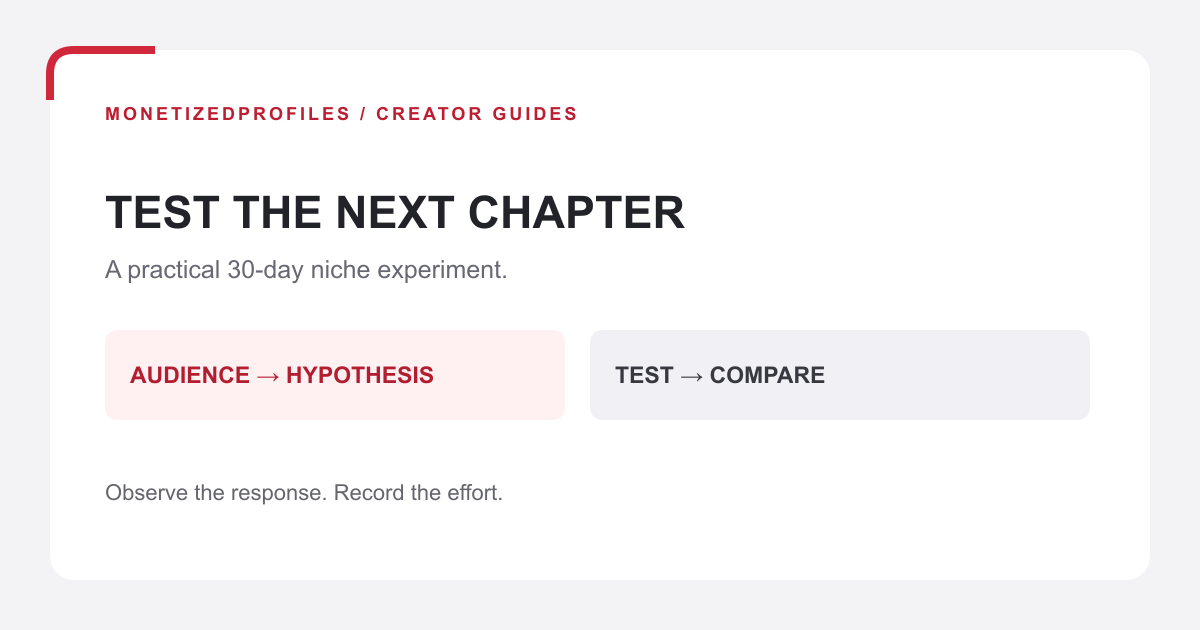
The practical approach: Define the audience overlap, publish a small set of bridge topics, and compare similar videos over equal observation windows. Record production effort alongside response. A 30-day test is a planning framework, not a promise of enough data or an algorithm reset.
Changing a YouTube channel's niche is a test of audience fit. The existing subscriber count tells you that people once chose to follow the channel; it does not tell you whether they want the new subject. Treat the change as a small editorial experiment before rebuilding the entire operation around it.
This 30-day plan is a suggested working schedule, not a YouTube rule or an algorithm-reset technique. YouTube’s guidance on pivoting content cautions that meaningful results can take months rather than weeks. Use day 30 to decide what to test next, especially if recent viewership is low.
Change the existing channel or start a second one?
Start with the viewer’s reason for watching. The following is our decision framework, not a rule about how YouTube will distribute a video. A second channel also needs its own production time and audience-building work.
| Situation | A useful next step |
|---|---|
| The new subject answers a related question for the same audience. | Try a bridge series on the existing channel before committing to a full change. |
| The new idea serves a different language, audience or viewing purpose. | Consider a separate channel; first check whether the team can support both. |
| Recent uploads have little usable audience data. | Treat the first uploads as baseline-building. Subscriber count alone cannot validate the pivot. |
| The current format works, but the team cannot sustain its cost. | Test a production change separately from a topic change so the result is easier to interpret. |
YouTube also identifies a second channel as an option for a distinct idea, while noting the added effort and cost. If you keep the existing channel, explain the new series to viewers in a short community update or description. Give them a specific reason to try it.
Days 1–5: define the audience you already have
Review a group of recent uploads rather than selecting only the biggest success. Record each video's subject, format, length, publication date and traffic mix. Keep Shorts separate from long-form videos when the viewing experience and production approach are different.
Write down the promise that connects the better-performing videos. A channel about aircraft accidents might attract people interested in investigation, engineering or aviation history. Those motivations suggest different next steps. Expanding from accident analysis into aviation engineering is a more specific hypothesis than declaring a move into 'education.'
YouTube’s content-analysis guidance recommends grouping comparable videos and checking whether one unusually popular upload distorts the pattern. Use a broader recent period to understand the existing channel, then use equal post-publication windows for the individual test uploads below.
Preserve the original observations in a dated sheet. If you repeatedly change the comparison period or exclude weak results after seeing them, you make it difficult to judge whether the new plan helped.
Days 6–10: design a small bridge between subjects
Choose a few topics that connect the existing audience's interests with the proposed niche. Keep the production workload within what you can actually finish. Write a one-sentence hypothesis for each video: 'Viewers who enjoyed our explanation of flight failures may also want a visual explanation of how the relevant system works.'
Change fewer things at once. If the subject, language, video length, narrator and editing style all change together, you will struggle to explain the result. That does not mean every video should look identical. It means the experiment should have a question you can answer.
Plan the title and opening together. List the question raised by the packaging and identify the moment when the video begins answering it. Avoid a long introduction that asks a new audience to wait for the reason they clicked.
Example: from accident analysis to aviation engineering
Suppose the existing channel explains aircraft accidents and the proposed direction is engineering. These are illustrative briefs, not tested audience results. Choose real cases only when you can verify the technical facts and obtain appropriate visuals.
| Bridge video idea | Audience hypothesis | Keep comparable |
|---|---|---|
| How a warning system helps a crew detect a problem | Viewers interested in an investigation may also want to understand the system behind it. | Language, narrator and explanation-led format |
| Why an aircraft system has a backup | Viewers may follow a shift from a failure story to the design decisions intended to manage it. | Similar length range and visual detail |
| How engineers test a proposed improvement | The audience may be interested in prevention as well as the original event. | Research standard, title clarity and opening structure |
Each brief moves one step away from the original topic. Record which step changes the audience response. Three videos are an example workload, not a required sample size or proof of demand; make fewer if that is all the team can properly research.
Days 11–23: publish and keep a decision log
Release the test videos at a pace that leaves time to inspect the finished work. Note what changed between uploads and why. If a confusing chart caused viewers to ask the same question, improve that explanation in the next video instead of changing the entire niche immediately.
Use YouTube's audience-retention report to inspect where attention drops or viewers revisit a section. Data typically takes one to two days to process. Where available, compare new and returning viewers, and remember that a spike can reflect confusion as well as interest. The chart is a prompt for investigating a moment in the video, not a complete explanation of why it happened.
Record production effort alongside audience response. A format that performs slightly better but requires three times as much research may need a different release schedule. Use your team's actual time and costs rather than a generic claim about what a niche should earn.
Days 24–30: compare like with like
Compare videos over similar amounts of time since publication. A video uploaded yesterday has had less opportunity to find viewers than one released three weeks ago. Consider topic, format and traffic source before attributing every difference to the niche.
Review the evidence in three columns: what improved, what worsened and what remains unclear. Include comments that describe what viewers found useful, but do not treat a handful of enthusiastic comments as a representative survey.
- Continue the test when the audience response is promising but the sample is small.
- Refine the format when the subject attracts interest but the explanation or production process needs work.
- Reconsider the pivot when the proposed audience and the content you can consistently produce do not fit.
A reusable comparison scorecard
Copy these fields into one row per upload. Pick a fixed observation window before comparing results, such as each video's first seven complete days. For a day-30 review, finish that observation window for every upload; move the review date if the final test video was released too late. That window is a working choice, not a threshold YouTube requires. Leave unavailable fields blank and label the result inconclusive when the sample is too small.
| Field | What to enter |
|---|---|
| Video and hypothesis | URL, subject and the audience connection you are testing. |
| Comparison window | Publication date and the exact period observed. |
| Comparable baseline | A previous upload of similar format and length; note relevant differences. |
| Audience response | Your recorded views, available retention observations and traffic mix for that period. |
| Production effort | Research, writing and editing hours, plus actual outside costs. |
| Interpretation | What the observations support, possible alternative explanations and unresolved questions. |
| Next action | Continue, revise or stop this specific test, with a reason. |
For example, a test video might have more views while taking much longer to produce and reaching a different traffic mix. That is mixed evidence, not an automatic win. Decide which uncertainty the next upload should resolve before increasing the publishing budget.
Keep monetization separate from the experiment
A different topic or a previously monetized channel does not remove ongoing content requirements. YouTube evaluates channels against its monetization policies. Keep original work and the rights to outside assets in the production review, regardless of whether the experiment gets more views.
If you are comparing monetized YouTube channels in our account catalogue, assess the existing topics, audience language and recent uploads against the videos your team can produce. An established subscriber count or monetization status does not guarantee that viewers will want a different niche. Review channel access and ownership checks separately from audience fit.
Questions about changing a channel niche
Is 30 days enough to decide?
Treat it as an initial checkpoint. Low recent viewership, different traffic sources or too few comparable uploads can leave the result inconclusive. Continue a focused test when it can answer a specific unresolved question.
Should I delete the old videos before testing?
This plan does not require deleting the existing catalog. First preserve a dated baseline and test the new audience proposition. Make any later catalog decision separately, after reviewing the consequences for the channel.
What if views rise but production takes much longer?
Review both outcomes. An illustrative change from 1,000 views in 10 production hours to 1,500 views in 20 hours raises views by 50%, but lowers views per production hour from 100 to 75. That comparison describes effort; it does not establish profit or predict the next upload.
Use the niche test planner
The interactive comparison below uses four inputs: baseline views, test views and the production hours for each video. Use the same observation window for both. Include research, writing, recording, editing and review in the hours.
- View change (%) = (test views − baseline views) ÷ baseline views × 100.
- Views per production hour = views in the observation window ÷ total production hours.
- Production-hour change (%) = (test hours − baseline hours) ÷ baseline hours × 100.
A zero-view baseline has no defined percentage increase, so the tool shows “No percentage baseline” instead of an infinite growth claim. Hours must be greater than zero; negative or missing inputs cannot produce a valid comparison. These calculations describe two uploads. They do not establish statistical significance, revenue, profit or likely future views. Repeat the comparison across suitable uploads and keep the raw observations.
Use our production workflow guide to identify expensive stages. If the proposed direction is history, our original history production workflow can help you define a more specific format.
Research checked September 20, 2026. The schedule and decision framework are editorial recommendations, not predicted results or a platform guarantee.